CATEGORY
The Operating System for Improvement.
Why a new category exists, why it exists now, and why we're building it.
THE THESIS
For thirty years, improvement has been a methodology in search of an operating layer. Lean, Six Sigma, Agile, Continuous Improvement — different names, similar disciplines, same operational problem: each one needed software, each one ended up running on spreadsheets, project management tools, and SharePoint pages.
The reason is simple. Generic project management tools (Asana, Jira, Monday) are good for delivery, weak for governance. Generic BI tools (Power BI, Tableau) are good for reporting, weak for execution. Bespoke build-it-yourself platforms are good for fit, terrible for total cost of ownership and lifecycle support.
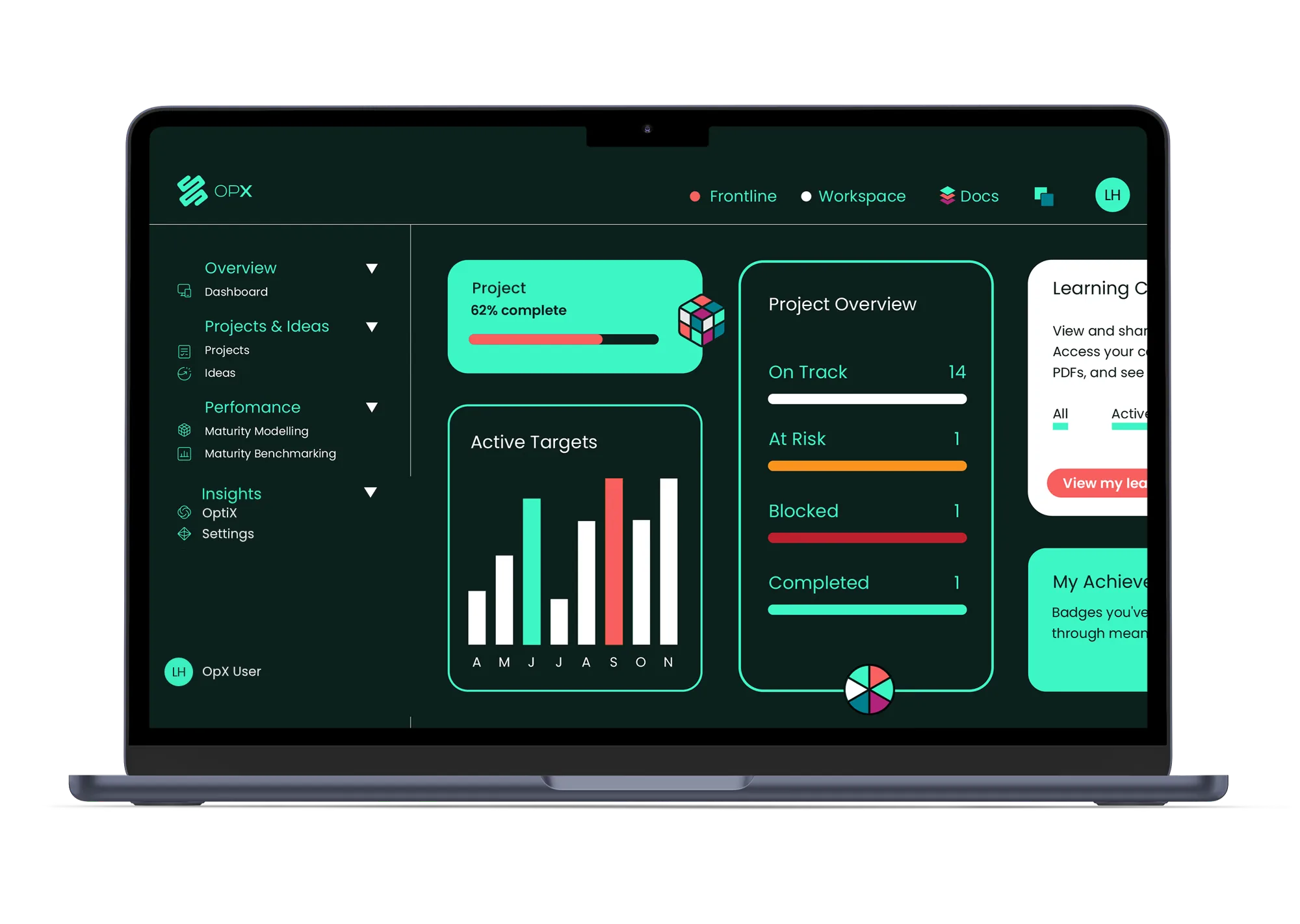
What's been missing is an operating layer designed specifically for the discipline of running improvement at scale: idea capture, project execution, benefits tracking, capability development, maturity assessment, governance — in one substrate, with the audit trail and the analytics built in by design rather than bolted on later.
That's the category we're building.
What the category looks like
An Operating System for Improvement is software that:
- · Captures the full improvement lifecycle from idea to outcome
- · Connects capability investment to project context
- · Runs governance as workflow rather than meetings
- · Embeds analytics at source rather than reporting after the fact
- · Scales from team to enterprise without architecture re-cuts
- · Sits alongside, not against, the rest of the enterprise tool stack
Why now
Three things make this category possible right now: managed-platform serverless infrastructure (Supabase, AWS), enterprise-grade SSO and SCIM via providers like WorkOS, and the maturation of practical AI features that earn their keep without requiring customer-data training. Together, they make a category-defining platform feasible at a price-point that doesn't require enterprise budget approval to start.
Why it's a category, not a feature
"Isn't this just project management for CI teams?" No — and the difference is the governance layer. Project tools optimise for delivery and treat audit, attribution and capability as add-ons. An Operating System for Improvement treats them as the substrate: governance runs as workflow, analytics sit at source, capability is a live database. You can't bolt that onto a delivery tool — it's an architecture, not a feature set.
CATEGORY EVOLUTION
From System of Record → System of Action → System of Foresight.
Every category-defining platform follows the same arc. The system of record wins first — then becomes the system of action, then the system of intelligence. Salesforce did it. ERP did it. ServiceNow did it. We're building OpX with all three layers in mind from day one.
NOW · 2024–26 · System of Record
"We see the improvement."
Every project, every saving, every stage-gate, every decision — captured. A single source of truth across CI, transformation and OpEx. Governance and audit embedded in the workflow, not bolted on afterwards. The wedge: visibility and defensible ROI for leaders.
NEXT · 2026–28 · System of Action
"We run the improvement."
Agents triage projects, score them, route them, escalate them. AI drafts business cases, generates baseline analyses, prepares stage-gate packs. Workflow automation orchestrates the stakeholders, approvals and comms. The wedge: cycle-time collapse and consistency at scale.
2028+ · System of Foresight
"It improves itself."
The platform reads operating conditions before they hit the P&L — and feeds execution directly. Response paths across the portfolio are simulated before any commitment is made. Improvement work is triggered autonomously: humans set policy, the system runs the function. The wedge: an operating function that compounds.
The bet: in ten years, no serious organisation runs improvement without OpX — because by then improvement runs itself, and we own the stack it runs on.
Read the full thesis →