01
Reports rebuilt every week.
Pulled from spreadsheets, Power BI, three SharePoint sites and someone's inbox. The next week, you do it again.
OpX OS
Capture ideas, run projects, prove impact. One platform, six faces, end-to-end audit trail.
Where OpX OS already runs
Improvement teams in defence, FMCG, telecoms and public services are building their operating layer on OpX OS.
 Rheinmetall Defence
 Innocent Drinks
 AGAS
AGAS Hotwire Communications
 Omran Oman
 Veygo
Veygo Admiral PioneerRheinmetall DefenceInnocent DrinksAGASHotwire CommunicationsOmran OmanVeygoAdmiral Pioneer
The problem
Ideas die in spreadsheets. Projects live in slide decks. Performance reports get rebuilt every Friday. SOPs go stale the day after their author leaves. Capability data is 90 days behind reality. And the audit trail — when finance, ISO or the regulator asks — is reconstructed from email.
OpX OS is one place where nothing falls through. Frontline capture connects to project execution. Project execution feeds dashboards. Dashboards roll up to the audit trail. The whole loop is the product — not eight tools you stitch together.
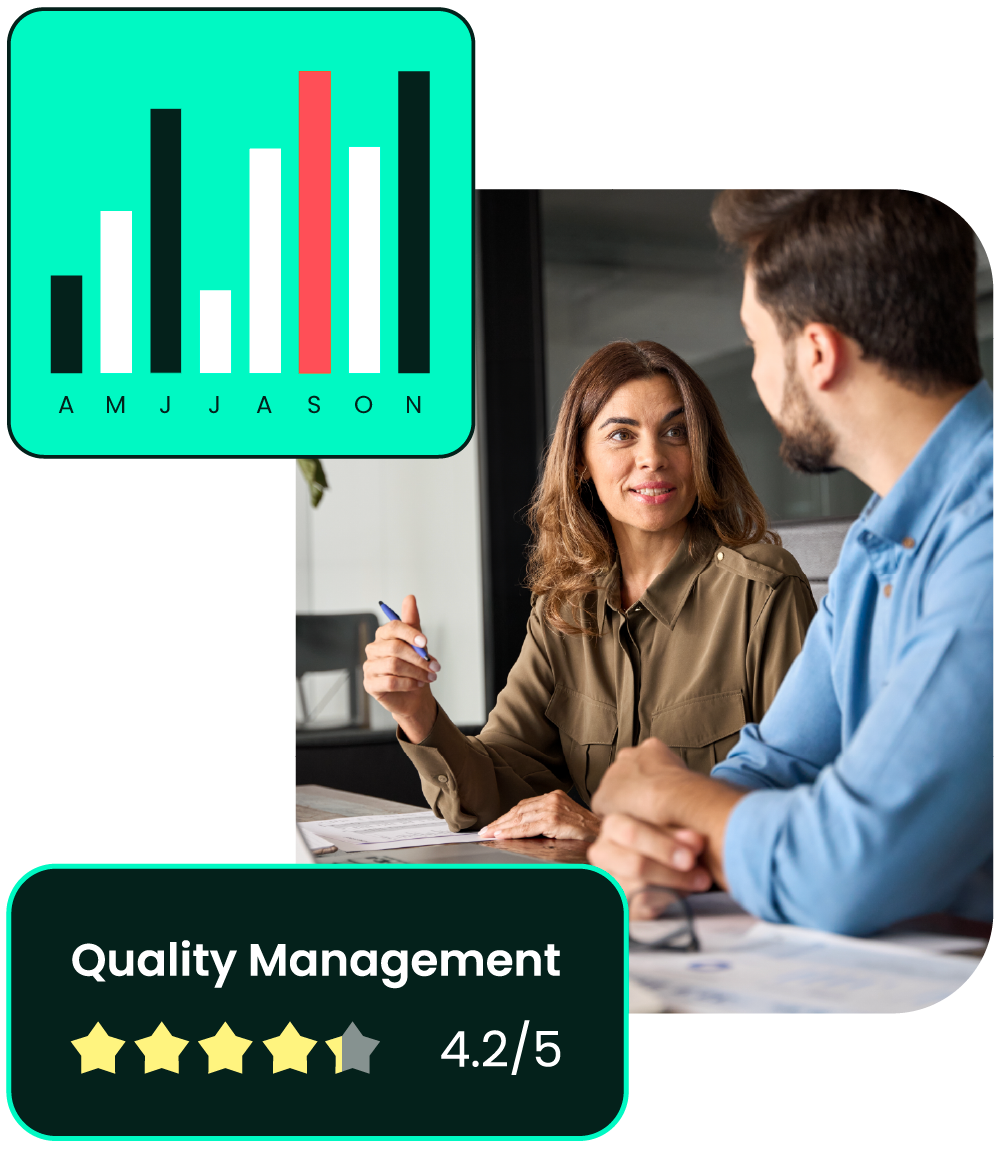
Why improvement initiatives stall
Pulled from spreadsheets, Power BI, three SharePoint sites and someone's inbox. The next week, you do it again.
Results are tracked differently across teams. By the time leadership asks what's actually working, you're rebuilding the story from memory.
Suggestions get logged in a form, routed to a manager, and never come back. Engagement collapses.
The CI lead spends 60% of the week chasing status updates instead of doing improvement work.

SteerCo decisions are six weeks behind what's actually happening in delivery.
SIX FACES OF OS
Six surfaces — leadership, measurement, methodology, ideas, people, capability — on one platform. Plugged into the systems you already run. Frontline to board, every site on the same page.

LEADERSHIP · Bridge
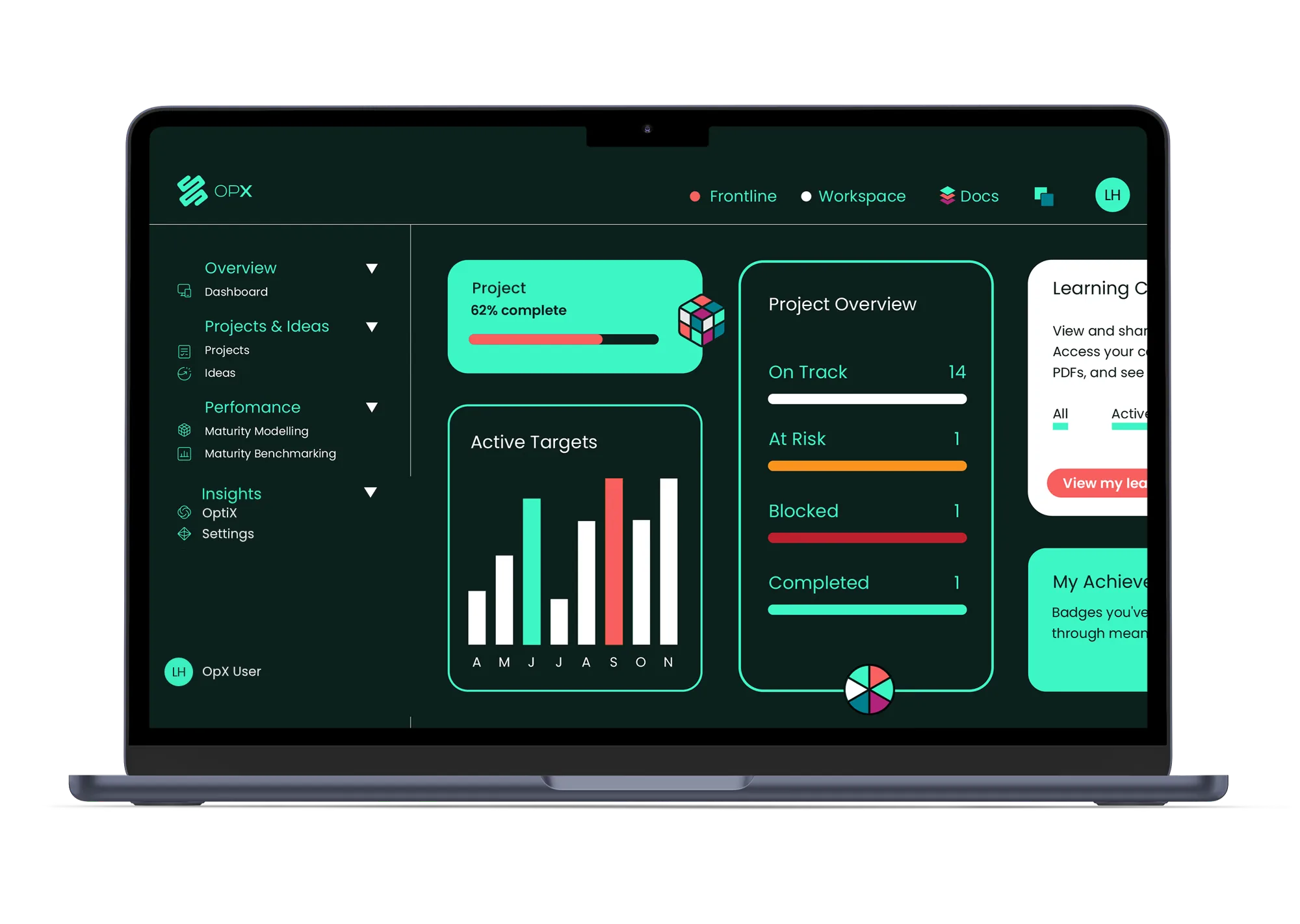
Bridge is where leadership lands when OS opens. Active improvements across the portfolio. Benefits booked, sustained, on watch. The OpX Index plotted against sector. Maturity by dimension, site by site. Every number is live — no spreadsheet assembly, no overnight reconciliation. The board pack the C-suite asks for is already populated when they walk into the room.

MEASUREMENT · Index
Index is OpX's maturity framework. Fifteen dimensions, validated against Cardiff University's body of knowledge. Run a campaign across every site in a click — same questions, same scale, calibrated baseline. Compare year on year, site to site, your benchmark against the OpX Index. Practitioners self-assess. Leaders see the truth. The gap becomes the next improvement project.

METHOD · Spine
Spine is the hero workbench every practitioner opens. A3, DMAIC, Kaizen, 8D, PDCA — all live the same way. Every stakeholder logged with role and influence. Every risk owned and rated. Every decision time-stamped with the person who made it. Fishbone, 5 whys, the actual problem-solving lives inside the platform — not in a separate file or a slide nobody can find. When a project closes, the system validates the methodology was followed. Closure is a system check, not someone's opinion.

INNOVATION · Hopper
Hopper is the idea pipeline. Frontline ideas screened, validated, sandboxed, scaled or retired. Every idea visualised by stage — size shows momentum, position shows impact, colour shows lifecycle. The pipeline isn't a spreadsheet you trust someone curated. Leaders find the patterns. The frontline see their ideas are taken seriously. Provenance traced end to end, from operator submission to scaled programme.
PEOPLE · Practice
Practice is the coaching and community layer. Coaches assigned automatically based on demonstrated capability. Sessions booked, evidence captured, the development of practitioners tracked alongside the development of projects. The community of practice — sites, regions, departments sharing certifications, what's working, what isn't. People run improvement. Practice makes sure the right people are matched to the right work, and the network around them lifts everyone up.

CAPABILITY · Foundations
Foundations is the accredited learning layer, delivered through the Lean Competency System via Cardiff University. Awareness, Foundation, Practitioner — the whole workforce on one pathway. Yellow Belt today, Green Belt next. No standalone LMS to license. No content gap to plug. The curriculum is here, and the certifications follow the practitioner — not just the employer. Built on what used to be Academy: same library, same accreditation, now native to OS.
PLUG IT IN
OpX OS plugs into the systems you already use — your identity provider, your data warehouse, your ITSM, your productivity stack. Open API, single sign-on, native connectors, signed webhooks. No replacement, no rip-out, no integration ticket you can't get a date for.
Six faces, five surfaces
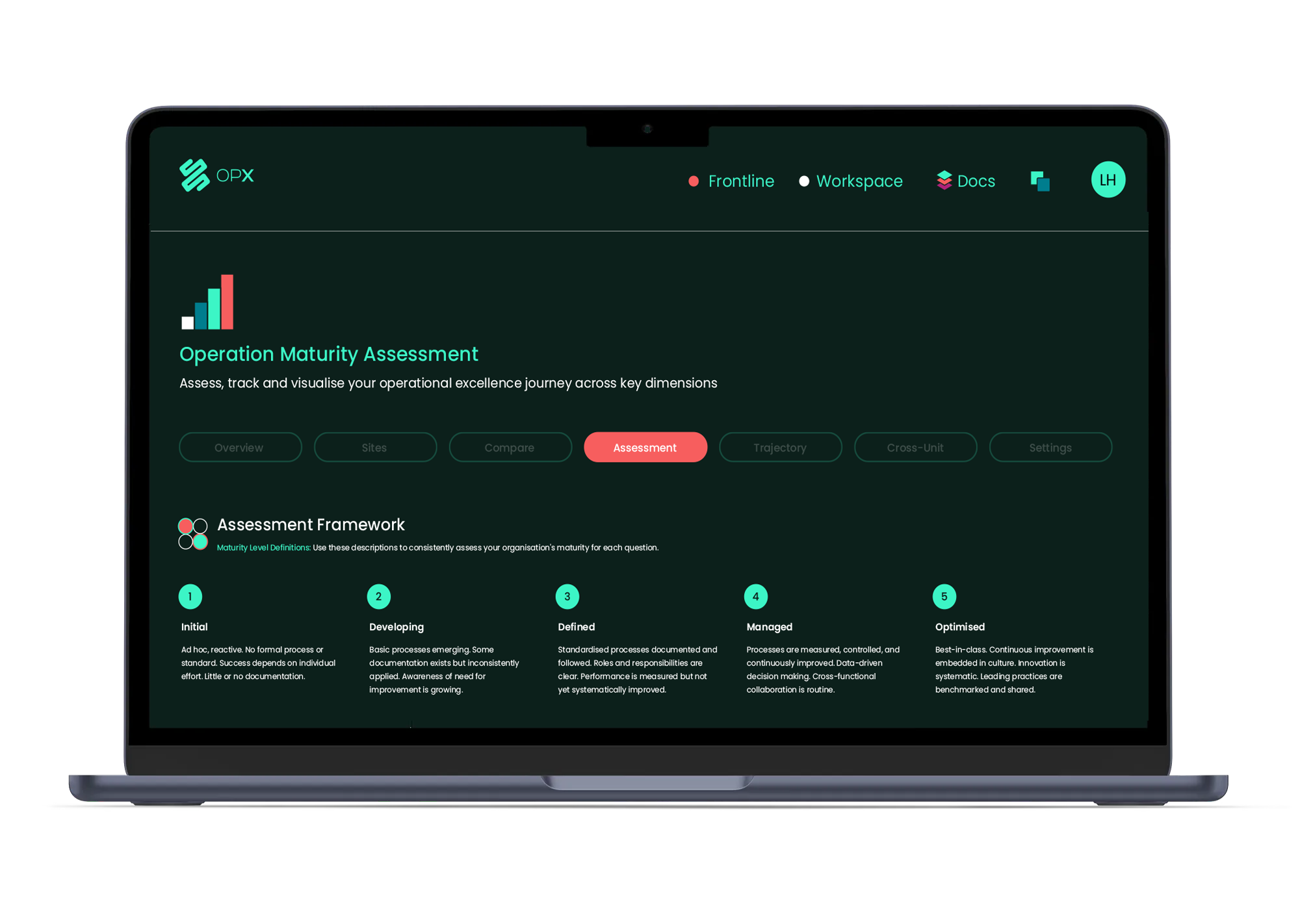
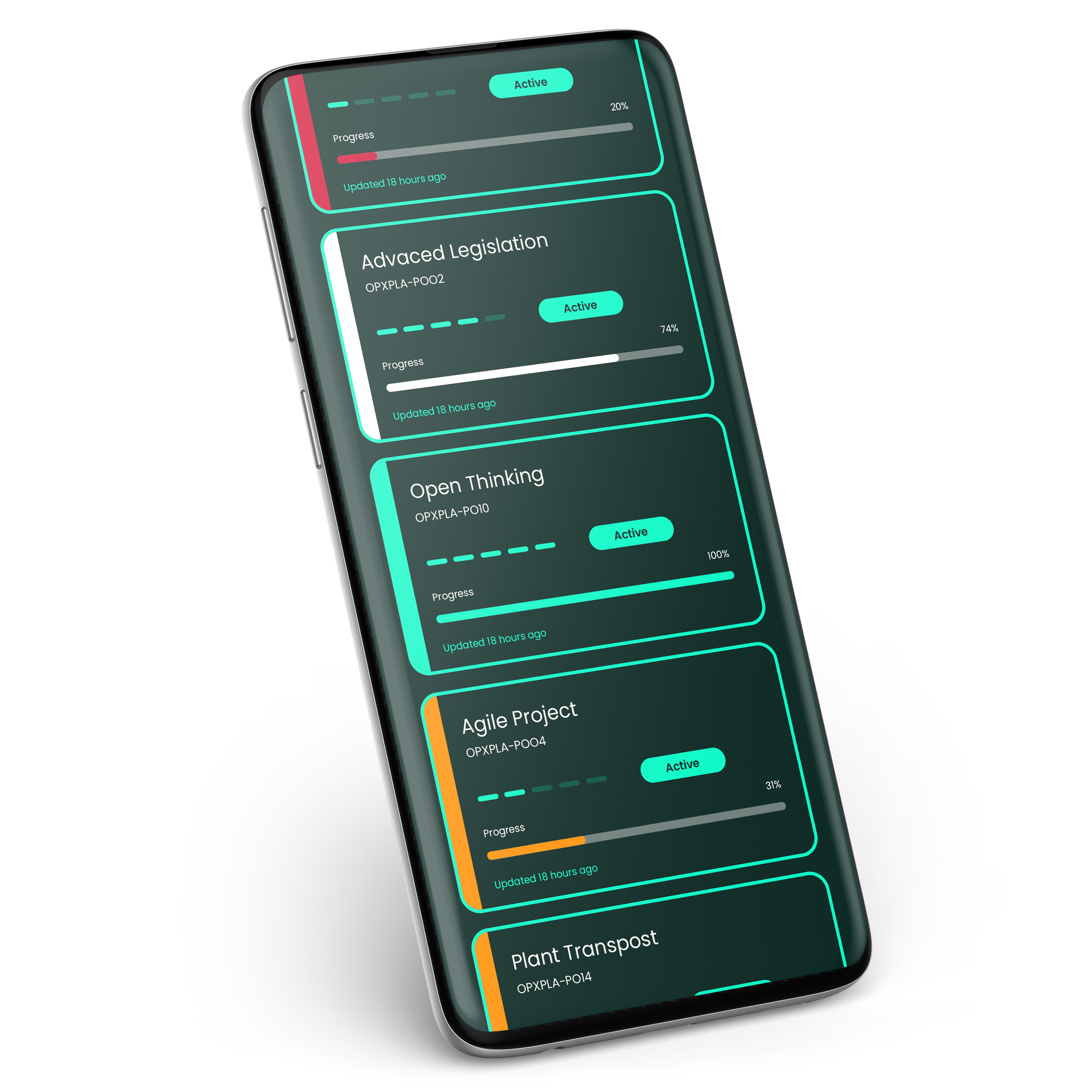
The Executive sees a live HUD and portfolio rollups. The Admin sees one Admin Home — SSO, audit, catalogue. The Operations Leader sees a TeamHUD — ops, projects, skills, learning on one screen. The CI Practitioner sees five method workspaces and the authoring tools. The Frontline sees idea entry, learning journeys and a personal capability heatmap. One operating layer underneath all five.
Built for the people you report to, not just you

Stop spending 60% of the week chasing status. OpX OS captures progress at source — five methods in one workspace, evidence captured in-flight.

See improvement activity across every function, site and sector on one operating layer — daily ops to SteerCo, live, not assembled.

Attribute pound-value to improvement work with non-repudiable attribution. Find the savings, defend the budget, make year-end a button press.

One configured platform replacing build-it-yourself sprawl. UK data residency, WorkOS SSO, tenant-level AI controls, 12-month audit retention.
The loop, not the list
Frontline capture feeds project execution. Execution feeds dashboards. Dashboards roll up to the audit trail. Capability and maturity data tell you where the next project should be. The whole loop is the system of record — which is why a result in OpX OS is traceable from the operator who raised the idea to the board pack that reports it.
What it replaces
Ideas in spreadsheets · projects in slide decks · reporting in Power BI rebuilt weekly · SOPs in SharePoint · skills in an Excel matrix · maturity in a quarterly deck · the audit trail in email. OpX OS doesn't ask you to rip out the enterprise stack — it replaces the improvement stack that was never really a system.
Indicative figures based on early customer engagements; results vary by organisation size and improvement maturity.
Trust signals
99.9%
Platform availability per calendar month
AWS eu-west-2
Primary region, London
≥12 months
Audit log retention
No training
AI features under no-training terms
PRICING
Two ways in. Both run on the same volume-tier ladder: the bigger the cohort, the lower the per-seat cost. Frontline access on OpX OS is included at no per-seat charge.
Start self-serve
from £295/mo
For teams under 25 Pro seats. Solo for the lone CI lead; Team for the group running the whole show. Stripe-billed, monthly or annual, cancel anytime.
See self-serve plansStart with a pilot
£5,000 fixed
The enterprise way in. A scoped 90-day rollout with a practitioner from the OpX team, creditable in full against Year 1. Then scale on Founding Cohort volume-tier pricing.
Run a 90-day pilotPast 25 Pro seats, self-serve upgrades into Founding Cohort enterprise pricing — Year 1 rates locked for 12 months. See full pricing →
You're here
The operating system for improvement work. Six faces, one operating office.
The integration layer
Open API, native connectors, signed webhooks. OS plugs into what you already run.
Explore Connect →Services & human delivery
Onboarding, cohorts, partner content, enablement. The human layer around OS.
Explore Campus →The accredited curriculum
LCS-accredited learning with Cardiff University. Now native to OS as Foundations.
Explore Academy →The AI layer
Context-aware AI on your delivery data. Guidance, triage, co-pilot — audit-trailed per invocation.
Explore Optix →